All Categories
Featured
Table of Contents

Methods for Expansion in UK Business Centers throughout 2026
British business are currently browsing an international trade environment that looks substantially different than it did even 2 years ago. In 2026, the push for worldwide growth needs more than simply capital. It demands an advanced understanding of localized consumer behavior and a management structure that can handle decentralized decision-making. Firms operating out of major commercial areas are discovering that the old designs of centralized control from a London head office frequently stop working to meet the rapid changes in foreign markets. Success in 2026 depend upon the ability to balance a unified brand identity with the flexibility to adjust to local subtleties.
Corporate leadership has moved its focus toward what lots of call dispersed governance. This includes empowering regional directors with the authority to make high-stakes decisions without waiting for approval from the office. Such a shift decreases the friction that usually decreases growth. When a company enters a new area, the speed at which it can respond to local competitors or regulatory changes identifies its long-lasting viability. Leaders who prioritize agility over overall control are seeing better results in the existing 2026 financial year.
Handling Financial Risk in International Territories
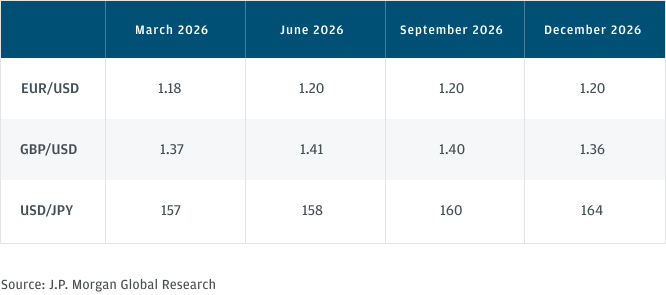
Currency volatility stays a constant issue for any business scaling across borders. In 2026, the pound sterling has experienced numerous changes affected by moving trade arrangements and domestic financial policies. To reduce these dangers, UK companies are progressively turning to sophisticated financial instruments. Automated hedging and multi-currency accounts are no longer optional extras but standard requirements for any service with a footprint in multiple continents. Maintaining liquidity in regional currencies assists firms avoid the costs connected with frequent conversions and safeguards their margins against abrupt devaluations.
Financial investment in GCC Strategy Consulting supplies the required information for making notified territorial entries. Without a clear photo of the fiscal obligations in a new country, services risk considerable tax charges. The 2026 regulative environment is particularly focused on digital services taxes and cross-border data transfer costs. Organizations must ensure that their monetary departments are equipped with the knowledge to browse these complicated tax laws. Working with local tax specialists or partnering with companies that specialize in global compliance has become a standard practice for mid-to-large-scale UK business.
Building Durable Supply Chains for 2026
The international supply chain has moved towards a more regionalized model. Rather of counting on a single manufacturing base in one part of the world, UK services are diversifying their production sources. This method, frequently referred to as multi-shoring, ensures that a disturbance in one area does not bring the entire operation to a halt. In 2026, the focus is on distance to the end consumer. By establishing production or assembly points closer to the target audience, business lower shipping times and lower their carbon footprint, which is an increasingly important metric for financiers and consumers alike.
Technology plays a significant function in managing these intricate logistics. Real-time tracking and predictive analytics enable supervisors to see prospective traffic jams before they trigger hold-ups. In 2026, these systems are incorporated into the core of business operation. Business that have bought these digital tools find it a lot easier to scale since they can preserve a high level of exposure over their goods, regardless of where they are in the world. This level of oversight is necessary for maintaining the quality requirements that British brand names are known for globally.
Leadership and Talent Acquisition in Urban Markets
Finding the best individuals to lead a worldwide growth is typically the most challenging part of the procedure. In 2026, there is a high need for supervisors who have both a deep understanding of the UK business culture and a high level of cultural intelligence in their target audience. The recruitment process has actually become more localized. Rather than sending out executives from the UK to manage operations in Asia or the Americas, firms are hiring regional professionals who already have actually established networks and understand the subtle social hints of the region.
Keeping a cohesive business culture across various countries is a major difficulty. When a business grows, there is a danger that its core values will end up being diluted. To prevent this, successful companies in 2026 are utilizing digital communication platforms to keep disparate teams linked. These aren't simply for conferences but for sharing the overarching objective of the company. Regular internal updates and collaborative jobs help staff members seem like they belong to a single global entity rather than a small, separated branch office. Professional advancement programs that enable internal mobility between various global workplaces likewise help in maintaining leading skill.
The adoption of GCC Strategy Consulting allows firms to preserve operational consistency throughout continents. When everyone is utilizing the very same systems and following the very same protocols, it is a lot easier to scale without wreaking havoc. This consistency is particularly essential in areas like client service and information security. A consumer in New york city should have the same high-quality experience as a consumer in Manchester. Achieving this needs a commitment to training and a strong digital infrastructure that can support global operations without lag or downtime.
Compliance and Legal Hurdles in 2026
The legal environment for international company has actually become more rigid in 2026. Data personal privacy laws, in specific, have actually seen a wave of updates throughout various jurisdictions. UK business should be watchful about how they manage consumer information, especially when it is being moved across borders. The charges for non-compliance are high enough to hinder a growth task completely. Legal teams are now investing more time on information residency requirements and making sure that their cloud storage companies meet the specific requirements of each country they run in.
Intellectual home protection is another area where companies must be proactive. In 2026, the increase of sophisticated digital duplication makes it easier for exclusive technology or brand assets to be misused. Registering trademarks and patents in every new market is a fundamental action, but it is not enough. Companies require to have active monitoring systems in place to identify and challenge violations quickly. This requires a dedicated legal budget plan and a determination to take part in litigation if essential to protect the company's most important properties.
Adopting a Strategic Development State Of Mind
Expansion is rarely a linear procedure. There will be problems and unexpected difficulties, whether they originate from political shifts, financial slumps, or modifications in consumer preferences. The most successful UK enterprises in 2026 are those that see expansion as a long-term dedication instead of a fast way to increase profits. This frame of mind involves a willingness to invest heavily in the early phases with the understanding that profitability may not be immediate. Persistence and a clear-eyed view of the dangers are necessary characteristics for any management group aiming to take their organization international.
Marketing research is the foundation of this tactical method. In 2026, this research study exceeds simple demographics. It involves a deep dive into the regional psychographics-- understanding what motivates customers in a specific region and how the brand name fits into their lives. UK firms that make the effort to conduct this level of research are far less most likely to make pricey mistakes when they introduce. They can customize their marketing messages and item offerings to meet the specific requirements of the local population, which develops trust and brand commitment much faster than a generic global campaign.
Functional performance is likewise a significant focus in 2026. As an enterprise grows, the complexity of its operations increases exponentially. Enhancing procedures and getting rid of redundancies is essential to keep costs under control. Lots of firms are utilizing expert system to deal with regular administrative jobs, which releases up human workers to focus on more complex problems. This usage of innovation is not about changing people however about making the international team more reliable. When the backend of business runs smoothly, the management team can invest more time on method and growth.
The role of the Chief Global Officer has ended up being more prominent in 2026. This person is responsible for overseeing all international operations and ensuring that they line up with the company's total objectives. They function as a bridge in between the local workplaces and the board of directors, supplying an unified vision for the whole company. Having a single point of accountability for global growth assists to guarantee that the growth remains on track which any problems are attended to before they end up being major issues. This central oversight integrated with decentralized execution is the trademark of the most effective global firms in the current economy.
Enterprises that are based in the UK have an unique benefit in 2026. The track record of British products and services for quality and reliability stays strong. By leveraging this track record and combining it with a modern, nimble approach to worldwide operations, UK firms can effectively compete on the world stage. The obstacles are significant, but for those who are ready, the opportunities for development in 2026 are large. The secret is to stay versatile, remain informed about local market conditions, and constantly keep the end consumer at the center of the technique.

Latest Posts
Regulation as Chance: The Silver Lining of 2026 Compliance
Measuring Digital Progress: A New Model for Mid-Market Firms
How CEOs Can Foster a Culture of Global Innovation